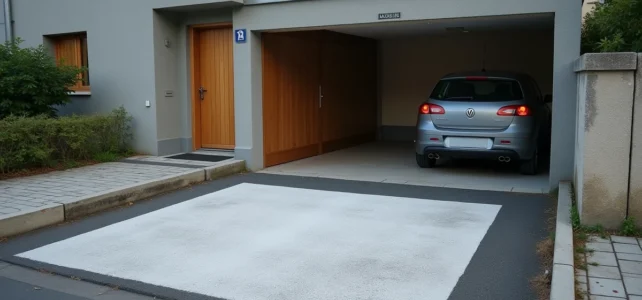
A vehicle that cannot exit its garage without encroaching on the sidewalk or blocking traffic is the kind of situation that quickly generates neighborhood conflicts. The clearance distance of a garage exit rarely depends on a single national rule: it is the local planning documents and the configuration of the land that set the real constraints.
Visibility Triangle at the Garage Exit: A Local Rule Often Ignored
When talking about clearance in front of a garage, most homeowners only think about the required setback length for maneuvering. The visibility triangle is a much more determining criterion for safety, and it is included in many recent local urban plans (PLU).
This triangle corresponds to an area free of any obstacles (solid wall, tall hedge, opaque gate) at the angle between the vehicle access and the public road. Common values in “Access and Road” zone regulations are around 2 m x 2 m, sometimes more depending on the width of the roadway. The goal: to allow the driver exiting to see a pedestrian or cyclist before proceeding.
Additional information can be found on the clearance of a garage exit on Déclic Auto, particularly regarding recommended setback distances based on configurations.
In practice, this local prescription changes everything for a fence or gate project. A solid block wall placed too close to the exit can be enough to render the access non-compliant, even if the setback distance is technically sufficient. Before building anything near a vehicle access, consulting the zone regulations of the local PLU remains the reflex to have.

Maneuverability in Front of the Garage: Setback Alone is Not Enough
Setting a linear setback distance (often five meters in neighborhood discussions) only covers part of the problem. Recent PLUs increasingly incorporate a maneuverability criterion: the vehicle must be able to enter and exit the garage head-on, without encroaching on the public road.
In practical terms, this means that the depth of the clearance area depends on several combined parameters:
- The width of the garage door and the approach angle from the road (a garage perpendicular to a narrow street requires more setback than a garage parallel to a wide road)
- The turning radius of the vehicle used, as an SUV and a city car have very different requirements
- The presence or absence of a sidewalk, ditch, or green space between the property line and the roadway
Feedback varies on this point depending on the municipalities: some require a complete turning area on the lot for new constructions, while others are satisfied with a minimum depth without specifying a typical maneuver. The building permit generally mentions these prescriptions in the access conditions to the lot.
Gate and Distance from the Public Road
The gate plays a direct role in the clearance. A swinging gate that opens outward can encroach on public property, which is prohibited unless specific authorization is obtained. The recommended distance between the gate and the road boundary is generally between two and three meters, precisely to allow a vehicle to park temporarily during opening without blocking traffic.
A sliding gate or an inward-opening swinging gate eliminates this encroachment issue, but the length of the interior clearance must remain sufficient to avoid trapping the vehicle between the gate and the garage door.
Inconvenient Parking in Front of a Garage Exit: What the Highway Code Says
One-third of conflicts related to garage exits do not concern the construction itself, but the parking of a vehicle in front of the access. The highway code prohibits parking in front of driveways. Article R417-10 qualifies as obstructive any parking that prevents the access or exit of a vehicle.
On the ground, having the infraction noted and obtaining the removal of the vehicle often remains laborious. Law enforcement intervenes upon reporting, but response times vary greatly from one municipality to another. Some preventive measures work better than recourse:
- Installing a visible private property sign with “vehicle exit” to deter wild parking
- Installing a garage exit mirror if lateral visibility is reduced by a wall or neighboring hedge
- Requesting the municipality to install bollards or a yellow line in front of the access on public property
The yellow line on the ground has no national regulatory value, but it is recognized as a usage signal by most motorists and significantly reduces abusive parking.
Accessibility and Passage Width: An Additional Constraint for New Constructions
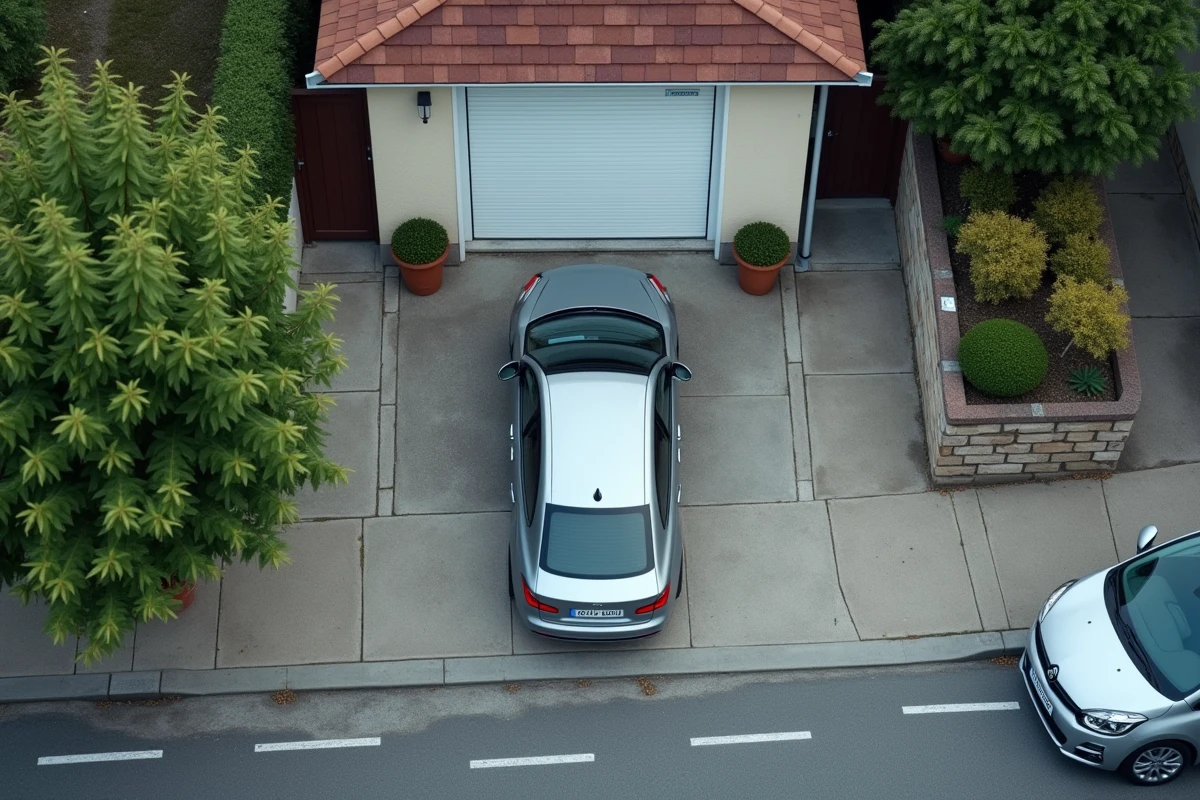
For new individual houses intended for sale or rent, accessibility regulations require that the pathway between the parking area and the main entrance meets minimum widths and maximum slopes. This pathway often runs in front of or beside the garage.
In practice, this may require planning for a clearance wider than what the vehicle maneuver alone would require. If the garage occupies the entire facade facing the street, a pedestrian passage accessible next to the parking area must be provided, which pushes back the position of the garage or gate relative to the property line.
This accessibility constraint does not appear in the majority of discussions about garage clearance, even though it directly conditions the placement of the building on the lot when applying for a building permit.
The clearance of a garage exit is not limited to a universal numerical distance. The combination of the local PLU, the visibility triangle, maneuverability criteria, and accessibility standards forms a framework that can only be mastered by reading the local regulations. Before any project, obtaining the operational urban planning certificate for the lot provides a complete view of the applicable constraints.