
A motocross bike is not designed for open roads. In France, riding this type of vehicle on public roads exposes one to heavy penalties, and the regulatory framework has tightened in recent years. This article measures the gap between what the law allows, what it prohibits, and what recent checks reveal on the ground.
Non-homologated motocross and road vehicle: the regulatory gap
The fundamental distinction lies in the CE certification, the certificate that attests that a vehicle meets European technical standards for circulation on public roads. A competition motocross bike does not have this certification. It falls into the category of non-homologated vehicles, alongside quads, mini bikes, or pit bikes.
The highway code prohibits the circulation of these vehicles on roads, paths open to the public, sidewalks, and bike lanes. This prohibition also covers forest paths and trails as long as they are not strictly private.
| Criterion | Motocross (non-homologated) | Enduro bike (road homologated) |
|---|---|---|
| CE certification | No | Yes |
| Registration document | Not issued | Mandatory |
| Circulation on public roads | Prohibited | Allowed |
| Lighting / indicators | Absent | Compliant |
| Technical inspection (since April 2024) | Not applicable (not registered) | Mandatory according to schedule |
| Civil liability insurance | Mandatory even off-road | Mandatory |
| DICEM declaration | Mandatory if speed > 25 km/h | No (classic registration) |
This table summarizes the gap between the two categories. Even if the rider adds a headlight or a mirror, the motocross bike remains a non-certified vehicle, thus excluded from public circulation. Taking out a motorcycle insurance tailored to the vehicle is also mandatory for any motorized machine, even when it only operates on private land.

Penalties for a motocross bike riding on the road
The consequences are not limited to a simple fine. Riding a non-homologated vehicle on public roads constitutes an offense, not a minor infraction.
- Fines of up to 3,750 euros, far exceeding a simple parking ticket or speeding fine.
- Immediate immobilization of the vehicle by law enforcement, with impoundment.
- Permanent confiscation of the bike, ordered by the court in case of recidivism or aggravating circumstances.
- Point deduction from the driver’s license if the rider has one, as the offense is linked to the driver.
In the event of a bodily injury accident, the lack of CE certification significantly complicates coverage by the insurer. The uninsured rider risks having to compensate the victim from their own funds, with no cap.
Motorcycle technical inspection and end of “road-legal” modifications
Since April 15, 2024, technical inspection is mandatory for registered motorcycles used on public roads. This measure, staggered according to the year of registration, does not directly concern motocross bikes as they do not have registration documents.
However, it closes a door that some used: registering a heavily modified machine by presenting it as compliant with noise, pollution, and safety standards. The technical inspection specifically checks these points. A rough modification (non-compliant exhaust, makeshift lights, absence of reflectors) will be detected and penalized.
This measure has an indirect effect on the market for “road-legal” motocross bikes. Practitioners who added a lighting kit and a silencer to obtain registration now face an additional filter. The technical inspection makes these modifications detectable and punishable.
Increase in on-site checks
Operations targeting non-homologated vehicles on the road have recently multiplied. Local press documents this trend, with seizures of mini bikes, quads, and motocross bikes intercepted in urban areas or on open paths. Law enforcement applies a cumulative penalty: fine, immobilization, and confiscation in the same procedure.
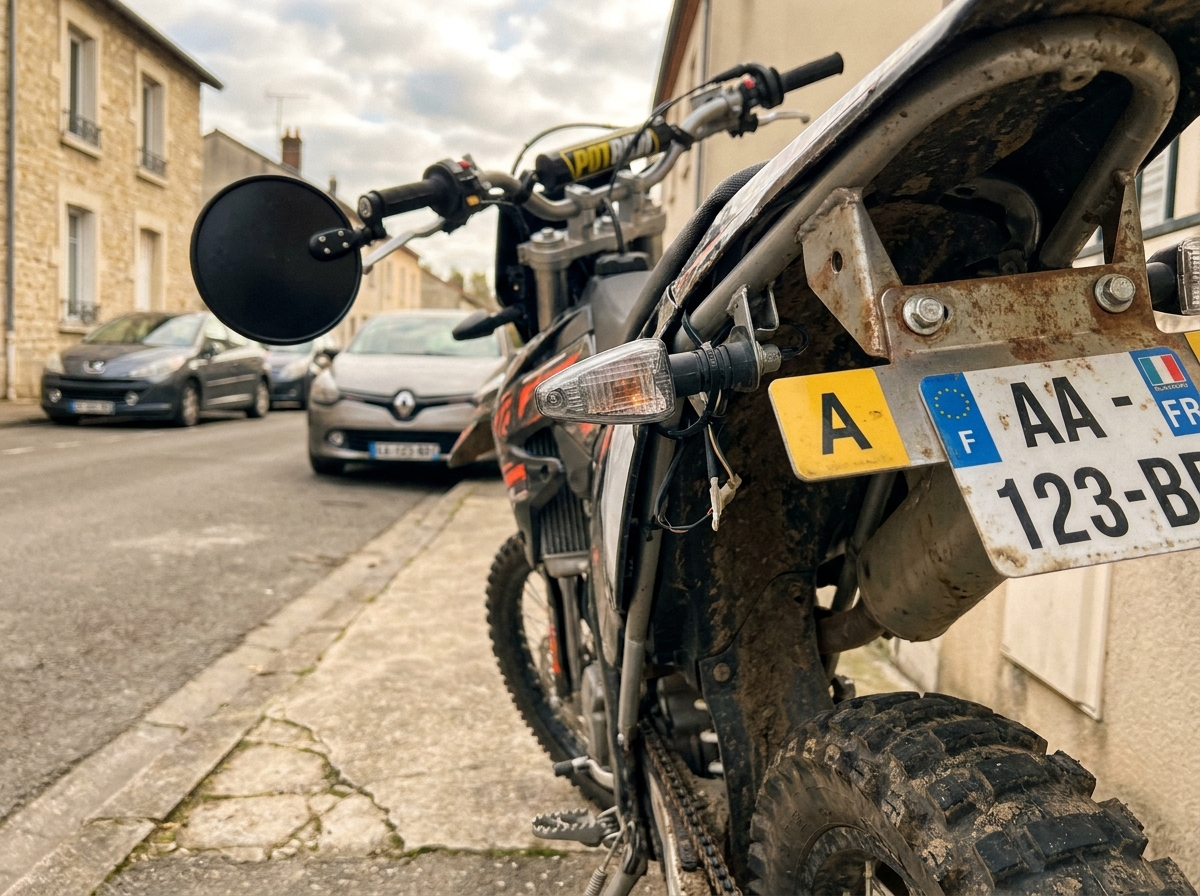
DICEM declaration and insurance: obligations even off public roads
Owning a motocross bike involves administrative procedures, even without ever touching the pavement. The DICEM declaration is mandatory for any non-homologated vehicle whose speed can exceed 25 km/h by design. This declaration does not grant any right to circulate on the road; it only serves to identify the vehicle and its owner.
Civil liability insurance is also required as soon as the vehicle is put into circulation, whether on private land, a circuit, or a dedicated track. Riding without coverage exposes one to a specific fine and, in case of damage to a third party, to potentially heavy personal debt.
Age conditions for purchase and use
The framework varies according to the rider’s age. Individuals aged 18 and over can buy, rent, and use a non-homologated vehicle. Minors aged 15 to 17 can rent and use a motocross bike, but not purchase it. Below 15 years, use is even more regulated.
Authorized terrains and circuits for motocross practice
The only legal practice of motocross takes place in spaces specifically designated for this purpose: circuits homologated by the French Motorcycle Federation, private lands with the owner’s permission and compliance with noise regulations, or during organized rides on closed circuits.
Riding in forests, on rural paths, or municipal roads remains prohibited, even if these spaces seem deserted. The environmental code protects natural areas against the circulation of motor vehicles outside of public roads. Offenders face additional penalties, distinct from those of the highway code.
The boundary between private land and regulated space remains the most frequent point of confusion. An owner who opens their land to third parties for motocross sessions enters a different regime: declaration obligation, compliance with noise standards, and possibly a development permit depending on the case.
The French legal framework leaves no gray area on one point: a non-homologated motocross bike has no place on public roads. Alternatives exist, but they all involve dedicated terrains or complete homologation of the vehicle.