
An invoice received by mail, re-entered into a spreadsheet, then sent by email to the accountant who re-enters it into software. This absurd journey still exists in many French SMEs. The digitization of processes involves replacing these manual circuits with digital flows where information circulates without re-entry, without delay, and without loss. Understanding this mechanism allows for identifying real productivity gains, not those promised by marketing rhetoric.
Process mining: mapping before digitizing
Before choosing a tool, you need to know where time is being lost. Have you ever noticed that a purchase order takes three days to move from one department to another while the processing itself takes ten minutes? The problem rarely lies in the task, but in the queues between tasks.
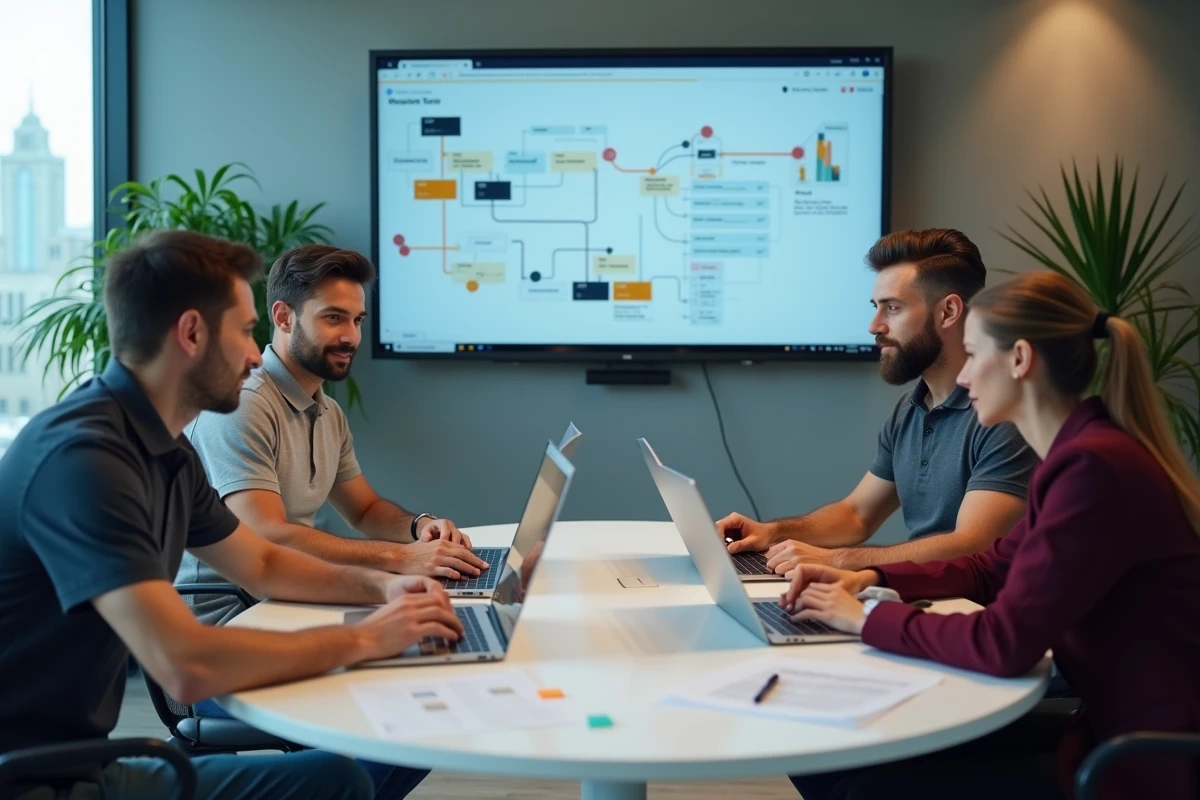
This is exactly what process mining reveals. This method involves analyzing the event logs of your software (ERP, CRM, messaging) to reconstruct the actual journey of a document or request. Tools like Celonis or UiPath Process Mining extract this data and produce a visual map of the process as it occurs, not as it is described in a procedure.
According to the Everest Group (report “Process Mining State of the Market 2023”), this approach is becoming a standard in large industrial groups and financial services in France. It allows for quantifying productivity gains before and after digitization, which changes the nature of decision-making: it shifts from intuition to calculation.
For smaller organizations, the reasoning remains the same without the specialized tool. A simple timing of the steps in a recurring process (order processing, quote validation, employee onboarding) is enough to identify bottlenecks. Platforms like Omniz then allow for connecting software components to streamline these sequences.
Automation of repetitive tasks: what really pays off
Automation is one of the oldest promises of digital technology. The difference today is the granularity. We no longer automate an entire department at once: we target a specific task, measure the result, and then move on to the next.
Three types of tasks to prioritize for automation
- Multiple entries of the same data. Every time an employee copies information from one system to another, it poses a risk of error and wastes time. A connector between software eliminates this step.
- Email validation circuits. A quote sitting in an inbox does not progress. A digital workflow sends the request to the right person, with automatic reminders in case of delays.
- Manual reports compiled in spreadsheets. When data already exists in your tools, a real-time dashboard replaces weekly compilation.
The most profitable automation targets frequent, low-value tasks. A process executed twice a year does not justify software investment. A daily process that takes thirty minutes, on the other hand, represents over a hundred hours a year.
Digitization and European regulatory constraints
Digitizing does not just mean going faster. For several years, European regulations have imposed requirements that make certain digitizations mandatory, not optional.
The DORA regulation for the financial sector
The Digital Operational Resilience Act (DORA), applicable from January 2025, concerns banks, insurance companies, and financial service providers. It requires digitizing critical processes with strict resilience and traceability requirements, including regular business continuity testing.
In practical terms, this means that companies in this sector can no longer settle for an isolated tool. The digital architecture must ensure data availability and the ability to operate in degraded mode.
The CSRD directive and ESG data collection
The European CSRD directive mandates, for financial years starting from 2024 for large companies, a detailed and auditable non-financial reporting. Environmental, social, and governance data must be collected in a standardized manner.
Without a dedicated digital process, this collection relies on file exchanges between departments, with the risks of inconsistency that this entails. Therefore, digitizing the ESG data collection chain becomes a matter of compliance, not just efficiency.

Change management: the factor that determines success or failure
A perfectly configured software that is ignored by teams produces no gains. Resistance to change is not a mentality issue; it is a deployment design issue.
Why are some tools adopted in a few days while others remain underutilized for months? The difference often lies in three concrete factors:
- Does the tool replace a task that the employee considers tedious? If so, adoption is quick. If the tool adds a step to a process that the user found simple, resistance will be strong.
- Is training conducted at the workstation, using real daily cases? A theoretical session in a classroom has little lasting effect.
- Is feedback visible? Showing concrete results in the first weeks accelerates buy-in. A shared dashboard displaying time saved works better than a speech on digital transformation.
The digitization of processes is not just about choosing software. Prior analysis of flows, targeting tasks for automation, considering regulatory constraints, and preparing teams form a whole. Companies that address these four dimensions in parallel achieve measurable results. Those that focus solely on the tool often end up digitizing a flawed process, which amounts to accelerating a circuit that was already not functioning.